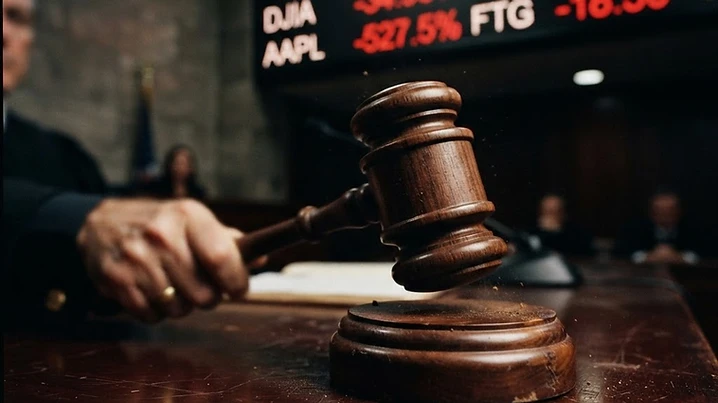
The king of the short sellers has been dethroned, and the crown is now a heavy piece of evidence in a federal penitentiary. Andrew Left, the man whose Citron Research reports could once vaporize billions in market cap with a single tweet, was found guilty by a federal jury in Los Angeles on 13 of 17 counts of securities fraud. The verdict, delivered on June 1, 2026, after just two days of deliberation, sends a chilling message through the canyons of Wall Street: the line between aggressive advocacy and criminal manipulation has finally been drawn in ink.
For years, Left operated in the gray zones of the market, framing himself as a financial vigilante exposing corporate rot. But prosecutors painted a far darker picture. They described a 'bait and switch' artist who used his massive social media following to move stocks, only to secretly trade against his own public recommendations. In one particularly damning piece of evidence, Left was caught describing his strategy as 'taking candy from a baby.'
The Verdict that Shook the Street
The trial, which lasted three weeks, focused on a series of trades involving some of the most recognizable names in the modern economy. Nvidia, Tesla, Roku, and Palantir were not just tickers on a screen; they were the instruments Left allegedly used to orchestrate a $20 million fraud scheme. The Department of Justice argued that Left would take a position, broadcast a sensationalized thesis to his followers, and then close out the trade for a profit the moment the market reacted—often at prices far different from the 'target prices' he publicly touted.
This wasn't just about being wrong on a stock; it was about the deception of intent. The jury found Left guilty of one count of participating in a securities fraud scheme and 12 individual counts of securities fraud. While Left has already signaled his intent to appeal, framing the conviction as a First Amendment issue, the legal reality is stark. His sentencing is scheduled for August 31, 2026, and the potential prison time could effectively end the career of one of the most polarizing figures in finance.
A First Amendment Defense?
Left’s legal team argued throughout the trial that their client was simply sharing opinions in a free market. They contended that punishing a short seller for having 'skin in the game' while expressing a view runs afoul of constitutional protections. However, the prosecution successfully countered that while opinions are free, fraud is not. The case hinged on the discrepancy between what Left told the public and what he did with his own capital.
'It’s one thing to publish a report saying you think a stock is overvalued while disclosing that you’re short,' noted one legal analyst following the case. 'It’s another to use your platform as a tool to execute a trade against the very people listening to you.' This distinction is what ultimately led to the guilty verdict, signaling that the SEC and DOJ are no longer willing to tolerate the 'short-and-distort' tactics that have plagued retail investors.
The Future of Activist Short Selling
The conviction of Andrew Left does not outlaw short-selling research, but it certainly reshapes the landscape. For other prominent activists like Carson Block of Muddy Waters or the team at Hindenburg Research, the verdict serves as a roadmap for what to avoid. The implicit message from the DOJ is clear: transparency is not just a best practice; it is a legal requirement.
As the dust settles, the short-selling community is left to wonder who is next. With the SEC implementing new rules like Rule 13f-2 to increase the visibility of large short positions, the era of the 'shadow short' may be coming to an end. For now, the man who once moved markets with a keystroke is waiting for a judge to decide his fate.
Key Takeaways
- Guilty Verdict: Andrew Left was convicted on 13 counts of securities fraud on June 1, 2026.
- Bait and Switch: The DOJ proved Left traded against his own public recommendations to net $20 million in profits.
- Target Stocks: The scheme involved high-profile companies including Nvidia, Tesla, and Palantir.
- Sentencing Date: Left is scheduled to be sentenced on August 31, 2026.
The Bottom Line
The conviction of Andrew Left marks the end of the 'wild west' era for activist short sellers. By proving that deceptive trading intent constitutes fraud, federal prosecutors have set a new, higher standard for transparency that will fundamentally change how short research is published and traded upon in the future.
Original reporting by Crypto Briefing. This article is desk analysis prepared by The Forensic Ledger from publicly available sources, summarized with citation to the original.
Not investment advice. This is original reporting and analysis prepared by The Forensic Ledger from publicly available data. Nothing here is a recommendation to buy, sell, or hold any security. Always consult the original source and a licensed professional. See our full disclaimer and source-citation policy.