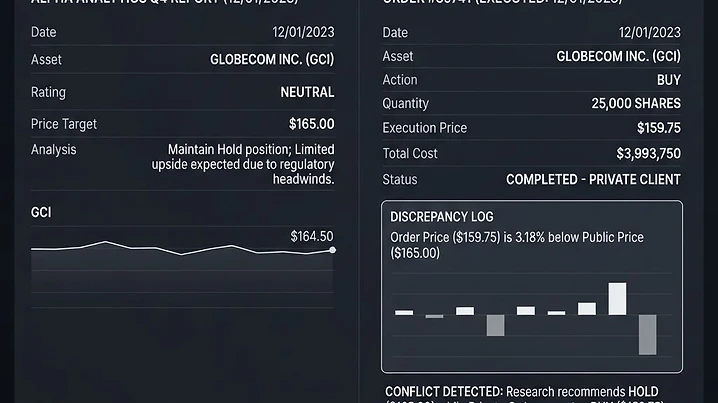
The conviction of Andrew Left and his firm, Citron Capital, represents a watershed moment for market oversight. Unlike traditional securities fraud cases that hinge on the falsity of the underlying research, the government’s successful prosecution focused on the disconnect between Left’s public commentary and his immediate, private trading activity. By utilizing short-dated options and limit orders that contradicted his own public price targets, Left engaged in what the Department of Justice characterized as 'scalping'—a form of market manipulation that prioritizes the exploitation of retail sentiment over genuine analytical discourse. The Forensic Ledger notes that this case establishes a dangerous precedent for activist firms: the 'independence' of a research platform is now a primary regulatory target. Even when a target company is legitimately flawed or under investigation, the act of coordinating positions with hedge funds or concealing compensation arrangements can trigger severe legal consequences. For issuers, the takeaway is clear: the defense against short attacks is no longer just about refuting the report's claims, but about documenting the timing of the short seller's trades relative to their public statements. As the SEC prepares for the implementation of Rule 13f-2 in early 2025, which mandates increased disclosure of gross short positions, the window for anonymous, manipulative 'short-and-distort' tactics is rapidly closing. The industry must now contend with a regulatory environment where the 'how' of a trade is scrutinized as heavily as the 'why' of the research. ## Sources - SEC Litigation Release 26056 — Official SEC charges against Andrew Left and Citron Capital, July 26, 2024. - Fenwick & West LLP — Analysis of the criminal conviction and its implications for market manipulation, 2026. - White & Case LLP — Overview of DOJ/SEC enforcement actions and the impact of Rule 13f-2, September 5, 2024.
Original reporting by Fenwick & West LLP. This article is desk analysis prepared by The Forensic Ledger from publicly available sources, summarized with citation to the original.
Not investment advice. This is original reporting and analysis prepared by The Forensic Ledger from publicly available data. Nothing here is a recommendation to buy, sell, or hold any security. Always consult the original source and a licensed professional. See our full disclaimer and source-citation policy.