Cardinal Infrastructure (NASDAQ: CDNL) Shares Plunge 36% After A.L. Grading Acquisition Issues Surface in Q2 2026 Results — BFA Law Opens Securities Fraud Investigation
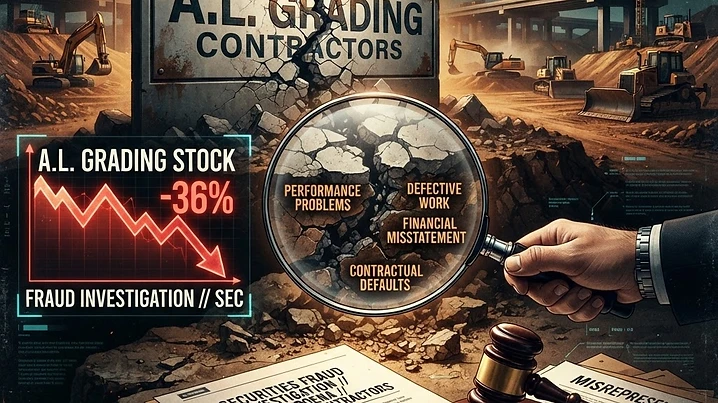
Bleichmar Fonti & Auld LLP (BFA Law) has opened a securities fraud investigation into Cardinal Infrastructure Group, Inc. (NASDAQ: CDNL) following a 36% single-session stock collapse on August 11, 2026. The law firm is investigating whether Cardinal misled investors about the performance of A.L. Grading Contractors, an acquired business whose cost overruns and scalability issues surfaced in Cardinal's Q2 2026 results and demolished the margin profile the company had previously guided investors to expect.
Epistemic note. A law firm investigation is a preliminary step that may or may not result in a filed action. The Forensic Ledger is reporting on the existence and substance of the investigation and the underlying earnings disclosure, not adopting BFA Law's allegations as established fact. Cardinal Infrastructure is entitled to dispute the claims, and no adjudication has occurred.
The August 11, 2026 earnings detonation
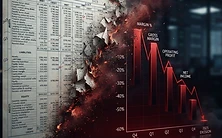
The unmasking came on August 11, 2026, when Cardinal reported Q2 2026 results. On the surface the top line looked healthy — revenues increased year over year — but the margin print was a forensic red flag: adjusted EBITDA margin of only 12.4%, far below the 20%+ margin Cardinal had told investors to expect. The company attributed the miss to increased costs and scalability issues, at least partially related to A.L. Grading Contractors, the acquired business at the center of the investigation. The market's reaction was immediate and severe: Cardinal stock dropped $21.73 per share, or over 36%, from a closing price of $60.00 on August 10 to $38.27 on August 11 — a single-session wipeout that erased roughly a third of the company's market value.
Why the A.L. Grading acquisition is load-bearing
Cardinal Infrastructure is a heavy construction infrastructure services company that went public in December 2025 and has grown through acquisitions — a roll-up profile in which the disclosed performance of each acquired business is the valuation. The BFA Law investigation targets whether Cardinal misled investors about the performance of A.L. Grading Contractors specifically. The forensic significance is that an acquirer's margin guidance is only as credible as the underlying performance of the businesses it has bought; if, as the investigation suggests, A.L. Grading was bleeding margin through cost overruns and scalability problems that were not surfaced to investors, then the 20%+ EBITDA margin narrative was structurally unsupported — and the 36% correction was the market repricing the gap between the promised profile and the actual one.
The roll-up disclosure architecture
For a recently public roll-up, the disclosure architecture around acquired-business performance is especially load-bearing. Investors in a December 2025 IPO-era company have limited operating history as a public entity to anchor on, and are heavily reliant on management's characterizations of acquired-business integration and margin trajectory. A 12.4% versus 20%+ adjusted EBITDA margin miss — a gap of roughly 760 basis points — is not a rounding error; it is the kind of divergence that, if preceded by reassuring commentary, forms the evidentiary core of a securities fraud investigation. The BFA probe is designed to examine what Cardinal knew about A.L. Grading's cost and scalability issues, when it knew it, and whether its public statements reconciled with that internal picture.
What would falsify the investigation's thesis
Falsification would look like: Cardinal demonstrating that its pre-August 11 margin guidance was reasonable at the time made, with the Q2 miss attributable to genuinely unforeseen post-guidance developments rather than known-but-undisclosed A.L. Grading problems; the investigation not resulting in a filed action or being resolved on terms that do not materially impair the business; and the company's margin profile recovering toward the 20%+ target in subsequent quarters. Corroborating developments would include internal documents showing earlier awareness of A.L. Grading's issues, further margin guidance cuts, additional disclosures of acquired-business integration problems, executive departures, restatements of acquisition-related financials, or additional class actions and derivative suits.
Source
⚖️ Editorial Disclaimer
This article is original reporting by The Forensic Ledger Desk on a law firm securities fraud investigation and the underlying Q2 2026 earnings disclosure. A law firm investigation is a preliminary step that may not result in a filed action. The Forensic Ledger is an independent newsroom and does not adopt BFA Law's allegations as established fact; Cardinal Infrastructure is entitled to dispute them, and no adjudication has occurred. This article is published for informational and journalistic purposes only, is not investment advice, and is not a recommendation to buy, sell, or hold any security.
Original reporting by GlobeNewswire. This article is desk analysis prepared by The Forensic Ledger from publicly available sources, summarized with citation to the original.
Not investment advice. This is original reporting and analysis prepared by The Forensic Ledger from publicly available data. Nothing here is a recommendation to buy, sell, or hold any security. Always consult the original source and a licensed professional. See our full disclaimer and source-citation policy.