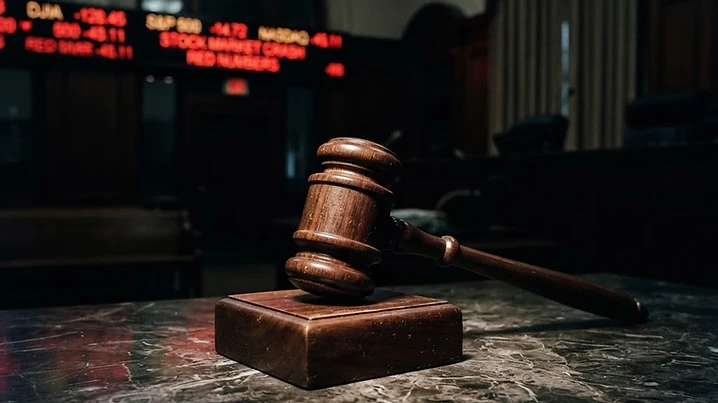
The gavel came down with the weight of a thousand margin calls in a Los Angeles federal courtroom this week. Andrew Left, the man who for two decades struck fear into the hearts of corporate executives with a single tweet, has been found guilty of securities fraud. The founder of Citron Research, once the most visible face of activist short selling, now faces a potential prison sentence that could span decades, signaling a brutal end to an era of unregulated social media market-moving.
For years, Left operated as a self-appointed financial sheriff, using his platform to call out what he termed corporate frauds and overvalued stocks. But prosecutors successfully argued that Left’s public persona was a carefully constructed facade. Behind the scenes, he wasn't just a researcher; he was a predator who used his influence to manipulate stock prices for quick, illicit gains. The Department of Justice and the SEC painted a picture of a man who would publicly trash a company like Nvidia or Tesla, only to quietly close his short positions the moment the market reacted to his sensationalized headlines.
The Mechanics of the 'Short-and-Distort' Scheme
The evidence presented during the trial was damning. Prosecutors detailed how Left would appear on major financial networks like CNBC, denouncing companies as "frauds" or "terminal shorts," while simultaneously instructing his traders to buy back the very shares he was telling the public to dump. In one instance involving Cronos Group, Left allegedly claimed to have covered only a "small size" of his position during a media appearance, when in reality, he had already exited more than 60% of his trade earlier that morning.
This "short-and-distort" tactic allowed Left to pocket an estimated $16 million to $20 million in illicit profits. The jury found him guilty on 17 counts of securities fraud and one count of making false statements to federal investigators. The conviction draws a sharp, bloody line between legitimate financial advocacy and criminal market manipulation. As the DOJ noted, you can share an opinion, but you cannot use that opinion as a weapon to execute a trade against the very people listening to you.
A Chill Through the Short-Selling Community
The verdict has sent a shockwave through the tight-knit community of activist short sellers. For firms like Muddy Waters and Hindenburg Research, the Left conviction is a double-edged sword. While these firms have historically served as a vital check on corporate misconduct—uncovering real frauds like Luckin Coffee and Nikola—they now operate under a regulatory microscope that has never been more powerful.
Legal experts suggest this case will reshape how short reports are published. The era of the "sensationalized tweet" may be over, replaced by a more cautious, disclosure-heavy approach. The SEC’s new rules requiring institutional money managers to file monthly reports on large short positions only add to the pressure. The "Dark Knights of Wall Street" are finding that the shadows they once inhabited are now flooded with the harsh light of federal scrutiny.
Key Takeaways
- Guilty Verdict: Andrew Left was convicted on 17 counts of securities fraud and one count of lying to federal agents.
- Trading Against Advice: The core of the fraud involved Left closing short positions immediately after his public reports caused stock prices to drop, contrary to his public recommendations.
- Financial Impact: The scheme allegedly generated approximately $20 million in illicit gains across stocks like Nvidia, Tesla, and Roku.
- Regulatory Precedent: This case establishes a clear legal boundary against using social media influence to facilitate "short-and-distort" trading.
The Bottom Line
Andrew Left’s conviction is a watershed moment for Wall Street, proving that even the most influential market commentators are not above the law when their public advocacy masks private manipulation. The verdict effectively ends Left’s career and serves as a stern warning to any activist investor who views their platform as a tool for personal enrichment at the expense of retail shareholders.
Original reporting by Wall Street Journal. This article is desk analysis prepared by The Forensic Ledger from publicly available sources, summarized with citation to the original.
Not investment advice. This is original reporting and analysis prepared by The Forensic Ledger from publicly available data. Nothing here is a recommendation to buy, sell, or hold any security. Always consult the original source and a licensed professional. See our full disclaimer and source-citation policy.