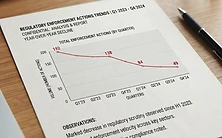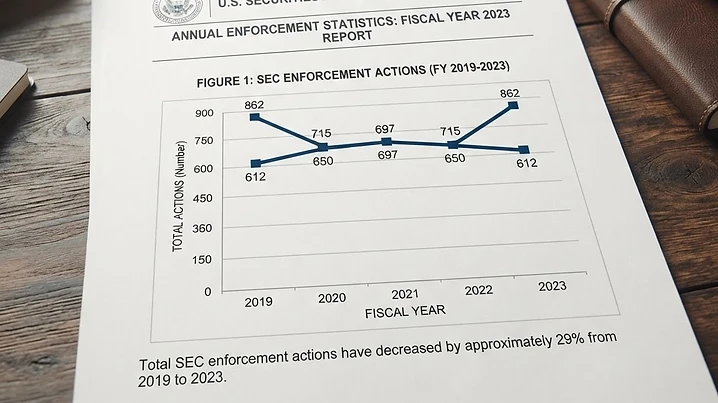
The Securities and Exchange Commission’s (SEC) Division of Enforcement has reported a marked decline in activity for fiscal year 2026, signaling a strategic pivot toward more targeted investigations. According to data released by Debevoise & Plimpton, the Commission brought 348 enforcement actions, a 24% decrease from the 456 actions initiated in FY 2025. More notably, monetary remedies plummeted to approximately $1.1 billion, a sharp contrast to the $17.9 billion reported in the previous fiscal year. This contraction follows a multi-year trend; standalone enforcement actions have declined by roughly 45% since 2024. Despite the lower volume, the SEC has established a 'Retail Fraud Working Group' to address Ponzi schemes, impersonation scams, and market manipulation. This shift suggests that the regulator is moving away from broad-based corporate reporting cases toward high-impact, retail-focused enforcement. For the forensic community, this decline in aggregate numbers does not necessarily imply a lack of oversight, but rather a change in the SEC's risk appetite. The agency’s decision to impose no civil penalties on companies like CBIZ Inc. and Key Tronic Corporation, citing their cooperation and remediation, highlights a growing emphasis on incentivizing internal compliance over punitive litigation. As the regulatory landscape shifts, market participants should monitor whether this 'less is more' approach effectively deters systemic fraud or creates a vacuum that activist short sellers will continue to fill.
Original reporting by Debevoise & Plimpton LLP. This article is desk analysis prepared by The Forensic Ledger from publicly available sources, summarized with citation to the original.
Not investment advice. This is original reporting and analysis prepared by The Forensic Ledger from publicly available data. Nothing here is a recommendation to buy, sell, or hold any security. Always consult the original source and a licensed professional. See our full disclaimer and source-citation policy.