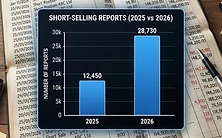
While regulators and the Department of Justice focus on the legal boundaries of short-selling, new academic research is quantifying the mechanical impact these activists have on market liquidity and price discovery. A study published by researchers from HEC Paris and Erasmus University Rotterdam tracked stock movements and lendable share pools following activist reports, providing a data-driven look at the "short seller effect."
The Power of the Target Price
The research, titled "Investors’ Quantitative Disclosure: Target Prices by Short Sellers," found that reports containing specific target prices—a quantitative disclosure—result in significantly higher immediate volatility and price depreciation compared to purely qualitative reports. According to the study authors, these quantitative targets serve as a focal point for market participants, accelerating the downward pressure on the stock. This finding adds a layer of complexity to the ongoing debate over "short and distort" schemes, as it suggests that the mere inclusion of a price target can be a potent tool for market movement, regardless of the underlying thesis's long-term validity.
Liquidity and the Lendable Share Pool
One of the study's most critical findings involves the contraction of the lendable share pool. When a short seller launches a campaign, the pool of shares available for borrowing often shrinks rapidly. This contraction can create a feedback loop: as shares become harder to borrow, the cost to maintain a short position increases, which can lead to the very "short squeezes" that have characterized recent market cycles. The researchers noted that the speed at which this pool shrinks is often correlated with the reputation of the short seller. High-reputation firms, such as Muddy Waters or Citron, trigger a much faster withdrawal of lendable shares than lesser-known entities.
Reputation as a Recovery Metric
The study also examined the long-term recovery of targeted stocks. It found that the market's response to a short report is heavily dependent on the short seller's track record. Investors were found to respond more aggressively to campaigns launched by sellers with a history of accurate fraud detection. Conversely, when a short seller with a weaker track record launches a campaign, the stock often sees a more rapid recovery as the initial shock wears off. This suggests that while short sellers can move markets in the short term, the market eventually "prices in" the credibility of the source, acting as a natural, albeit delayed, check on less scrupulous actors.
Key Takeaways
- Quantitative disclosures, such as target prices, significantly increase the immediate market impact of a short report.
- The pool of lendable shares for a targeted stock shrinks rapidly following a report, particularly when issued by a high-reputation firm.
- Short seller reputation is the primary factor in determining whether a stock price remains depressed or recovers in the months following an attack.
- The study provides a framework for understanding how activist short sellers influence market liquidity beyond simple price movements.
Sources
- HEC Paris — Summary of the study "Investors’ Quantitative Disclosure: Target Prices by Short Sellers," June 2, 2026.
- ScienceDirect — Evidence from public short campaigns and list of top activist short sellers, 2024.
Original reporting by HEC Paris. This article is desk analysis prepared by The Forensic Ledger from publicly available sources, summarized with citation to the original.
Not investment advice. This is original reporting and analysis prepared by The Forensic Ledger from publicly available data. Nothing here is a recommendation to buy, sell, or hold any security. Always consult the original source and a licensed professional. See our full disclaimer and source-citation policy.