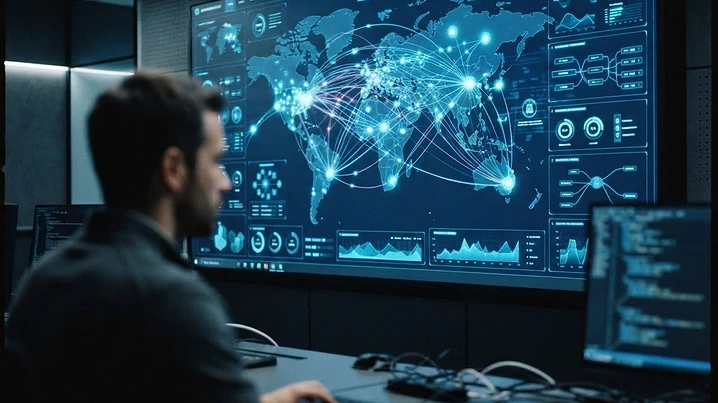
In complex undercover investigations involving multiple jurisdictions and agencies, the fragmentation of evidence and operational intelligence poses a significant risk to both officer safety and judicial outcomes. This coordination technology functions as a unified command dashboard, allowing task forces to maintain direct, encrypted control over authorized undercover handsets while synchronizing live intelligence. The system is designed to address the challenges of multi-agency oversight, ensuring that every communication and piece of evidence is logged, hashed, and attributed correctly.
Capability and Operational Oversight
At its core, the technology allows a lead agency to deploy and monitor authorized undercover handsets with granular permissioning. It serves as a secure central node for tasking and resource deployment. The system captures all interactions in real-time, providing supervisors with the ability to monitor the integrity of the operation as it unfolds. It acts as an encrypted 'black box' for the operation, recording audio, video, and text evidence that is immediately cryptographically sealed against future tampering.
Addressing the Operational Gap
Previously, evidence collected in undercover settings was often stored in disparate, siloed databases, increasing the likelihood of procedural errors during trial discovery. This platform closes that gap by automating the ingest process. By visiting Undercover Agent, authorized agencies can access frameworks for standardizing the capture and storage of undercover intelligence across jurisdictional lines. The technology ensures that evidence collected by one agency is instantly available to another, provided they possess the correct clearance, significantly reducing the 'silo effect' that frequently hampers multi-agency task forces.
Maintaining Evidence Integrity and Officer Safety
Safety is maintained through persistent, encrypted location awareness and heartbeat signals transmitted from undercover handsets to the command dashboard. If an operative enters a high-risk zone or their connection drops, the system triggers automated protocols. Regarding evidence, all incoming data is processed through an automated transcription engine. The system then correlates these transcripts with location data and digital timestamps, creating a searchable, chronological case file that is ready for legal review. Because the process is entirely documented within a controlled, closed-loop system, defense challenges regarding evidence tampering are effectively preempted by a verifiable audit trail.
Illustrative Operational Scenario
In a typical trafficking investigation involving agencies from three different municipalities, investigators use this system to synchronize their efforts. Each agency feeds data into a single, shared case file, while the dashboard provides a unified view of all active undercover handsets. As evidence is gathered—such as audio recordings of meetings—it is automatically hashed and uploaded to the centralized server. When the operation concludes, the system generates a comprehensive, forensically sound package that documents the entire chain of custody, ensuring that the evidence is immediately prepared for court without the need for manual reconstruction.
Key Takeaways
- Centralized command dashboards ensure real-time visibility for multi-agency task forces.
- Automated evidence hashing preserves the integrity of undercover captures from the point of collection.
- Real-time location monitoring and heartbeat signals prioritize the safety of field operatives.
- AI-assisted correlation turns disparate voice and text logs into a structured, searchable case file.
The Bottom Line
By standardizing the capture and management of undercover intelligence, agencies can ensure that evidence remains shielded from procedural challenges while maximizing the safety of those in the field.
Sources
- Undercover Agent - Technical guidelines for unified command and secure evidence management in law enforcement.
Original reporting by Undercover Agent. This article is desk analysis prepared by The Forensic Ledger from publicly available sources, summarized with citation to the original.
Not investment advice. This is original reporting and analysis prepared by The Forensic Ledger from publicly available data. Nothing here is a recommendation to buy, sell, or hold any security. Always consult the original source and a licensed professional. See our full disclaimer and source-citation policy.