"You Could Do The Surgery Yourself, Faster": Surgeons Tell Short Seller the LIBERTY Robot Isn't Worth the Extra $3,000
On May 14, 2026, White Diamond Research published a short report on Microbot Medical (NASDAQ: MBOT) setting a $1 price target, based in significant part on interviews the firm conducted with two vascular surgeons who have used the company's sole commercial product, the LIBERTY Endovascular Robotic System, in live clinical cases. The report states the firm began its research intending to potentially go long the stock ahead of the device's full market release, but says its sentiment reversed after the interviews and is now short MBOT.
Epistemic note. This report rests heavily on two named/anonymous physician interviews, an anonymous former MBOT employee interview, and White Diamond's own research team. Direct quotes below are as transcribed and published by White Diamond Research; The Forensic Ledger has not independently verified the interview recordings, the speakers' identities beyond what the report discloses, or the accuracy of the transcription. The characterizations of the LIBERTY as a commercial failure and MBOT's reimbursement strategy as "unrealistic" are the opinions of a short seller with a disclosed financial interest in the stock's decline.
"It's not ready to change the world yet"
White Diamond quotes an anonymous surgeon who has used the LIBERTY in live, post-FDA-clearance cases (not a trial) describing the device bluntly: "[The LIBERTY] is extra work, you could do the surgery yourself without the robot faster, with equal accuracy, and it's gonna cost you an extra $3,000." The same surgeon is quoted saying, "in its current form, I don't know that it's gonna impact our practice" and "it's not ready. It's not ready to change the world yet," while also describing the device's long-term potential to expand access to care in underserved areas as the reason for his continued involvement.
A second surgeon: used once every week to ten days
Dr. Charles Briggs of Tampa General Hospital, who agreed to be named in the report, told White Diamond he is, in his words, "the only person that's really using it" among the hospital's vascular surgery staff, and that he uses the LIBERTY "probably once every week, or every week and a half." Dr. Briggs said the device's current value to him is primarily radiation reduction and being able to remove his lead apron during use, but noted it is only compatible with .014" guidewires rather than the .018" wires he says are the market-leading standard, calling the smaller wire "a little bit flimsier, not as sturdy."
No reimbursement code, according to the interviewed surgeon
The anonymous surgeon told White Diamond there is "no reimbursement mechanism" for the LIBERTY disposable, which the report states costs hospitals an incremental $3,000–$4,000 per procedure, and that "there's not even a code for it." The report separately argues that MBOT's stated hope of securing a New Technology Add-on Payment (NTAP) reimbursement code faces two structural obstacles: NTAP requires demonstrated "substantial clinical improvement" over standard treatment, which White Diamond says the LIBERTY has not shown in peer-reviewed literature, and NTAP applies only to inpatient procedures, while the report states the majority of the vascular procedures the LIBERTY is used for are outpatient.
A single-use, fully disposable system
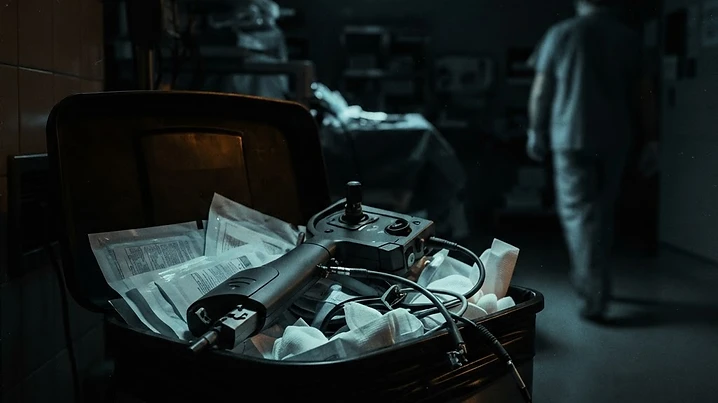
The report highlights that the entire LIBERTY system — including the remote control and robotic drive unit, not just a disposable catheter component — is discarded after a single use, which it characterizes as wasteful for both the hospital and the company. It cites a company-linked article in which CEO Harel Gadot is quoted describing this single-use design.
A former employee's account
White Diamond quotes an anonymous former MBOT employee involved in commercialization and go-to-market planning, who said he left the company over what he described as a "misalignment" in business approach, including characterizing some of CEO Harel Gadot's dealings with physician customers as "almost threatening at times." The former employee said the company lacked reimbursement infrastructure and, in his view, "didn't have the right plan" for one.
A parallel to a prior Gadot venture that shut down
The report notes that Gadot previously founded XACT Robotics, maker of a similarly radiation-reduction-focused robotic system for vascular and interventional procedures, which shut down in September 2023 after roughly four years following FDA clearance, citing an inability to generate significant revenue or raise further capital. White Diamond argues MBOT's cash burn trajectory — cited by Gadot at a Needham healthcare conference on April 15, 2026 as rising toward $2.5 million per month in 2026 against roughly $80 million in cash at the end of 2025 — puts it on a similar multi-year runway, compounded by an April 10, 2026 filing to raise up to $39 million via an at-the-market offering that the report says signals further share dilution.
The $1 price target
White Diamond states its $1 target reflects a valuation at or slightly below the company's projected late-2026 cash-per-share level, reasoning that if the LIBERTY proves commercially unviable, the stock should trade near cash value while the company burns through its balance sheet.
What would falsify this thesis
Falsification would look like: MBOT publishing peer-reviewed clinical evidence of substantial patient-outcome improvement sufficient to support an NTAP reimbursement application; broader adoption of the LIBERTY beyond the two academic hospitals (Emory and Tampa General) named in the report, including expanded use among Tampa General's own vascular surgery staff beyond Dr. Briggs; a version of the device compatible with the .018" guidewire standard; and a reimbursement pathway (commercial payer or NTAP) actually being secured. Conversely, continued single-digit or occasional per-week usage at existing sites, no expansion to new hospital systems, further dilutive capital raises, and rising cash burn without a reimbursement resolution would corroborate the thesis.
White Diamond Research's disclosed position
White Diamond Research disclosed that it, along with its clients, affiliates, and related entities, may have a short position in Microbot Medical and stands to realize significant gains if the share price declines.
Source
⚖️ Editorial Disclaimer
This article summarizes with citation a research report already published by White Diamond Research, including its published interview transcripts. The Forensic Ledger is an independent newsroom and archive; it is not the author of the underlying interviews or allegations and does not adopt them as established fact. All quotes attributed to surgeons and a former employee are as published by White Diamond Research and have not been independently re-verified by The Forensic Ledger. The characterization of the LIBERTY as destined for "commercial failure," the $1 price target, and the comparison to XACT Robotics are the opinions of a third party (White Diamond Research) that discloses a financial interest in the decline of the covered security. These claims have not been independently verified by The Forensic Ledger, have not been adjudicated by any court or regulator, and may be denied or disputed by Microbot Medical. This article is published for informational and journalistic purposes only, is not investment advice, and is not a recommendation to buy, sell, or hold any security.
Original reporting by White Diamond Research. This article is desk analysis prepared by The Forensic Ledger from publicly available sources, summarized with citation to the original.
Not investment advice. This is original reporting and analysis prepared by The Forensic Ledger from publicly available data. Nothing here is a recommendation to buy, sell, or hold any security. Always consult the original source and a licensed professional. See our full disclaimer and source-citation policy.