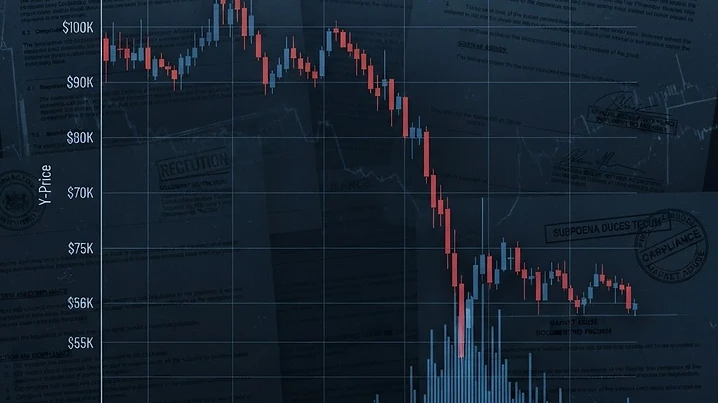
Federal prosecutors and securities regulators have reshaped the operational blueprint for forensic short sellers following the criminal conviction of Citron Research founder Andrew Left. While activist short selling has long occupied an aggressive posture on Wall Street, Left's conviction establishes a distinct precedent: the legal hazard lies not merely in what researchers publish, but in whether their market execution directly contradicts their public thesis.
The Mechanics of the Prosecution
According to legal analyses from Fenwick & West LLP, the government's criminal case against Left did not center on whether his underlying research reports were substantively false. In several instances, companies targeted by Citron were subsequently probed or penalized by financial regulators for deceptive practices. Instead, prosecutors focused on trading behavior and disclosures. Specifically, Left was accused of orchestrating rapid reversals—establishing short positions, publishing sensationalized price targets, and quickly covering positions as retail and institutional investors rushed to exit, capturing profits from short-term market turbulence.
This distinction marks a structural shift in how authorities define "short-and-distort" campaigns under federal securities laws. Historically, enforcement against market manipulation required establishing demonstrably fabricated facts or orchestrated false rumors. In Left's trial, federal prosecutors successfully argued that promoting long-term target prices while quietly taking immediate profits on transient liquidity constitutes actionable securities fraud.
Heightened Issuer Defense and Regulatory Architecture
The ripple effects of the conviction coincide with systemic changes in short-sale visibility overseen by the Securities and Exchange Commission (SEC). Under SEC Rule 13f-2, institutional investment managers face mandatory Form SHO reporting for gross short positions exceeding $10 million or 2.5% of outstanding shares. This creates an auditable trail of position timing that makes rapid-turnaround campaigns far easier for regulators and corporate targets to monitor.
For corporate governance and board-level risk management, legal counsel is advising public issuers to monitor options order flow, borrow availability, and rapid covering patterns immediately around negative publications. Rather than simply pursuing defamation claims—which frequently fail or expose issuers to counter-scrutiny—corporations are increasingly turning to forensic data analyses to identify anomalous trading mismatches.
The Forensic Ledger Desk Analysis
The conviction introduces an existential compliance challenge for activist short research firms. While research exposing genuine corporate wrongdoing remains legally protected, the financial model of monetizing short campaigns requires strict behavioral consistency. Firms that publicly project catastrophic downside but routinely cover on day-one drawdowns now face direct exposure to market manipulation charges. Activist research will inevitably tilt toward institutional, long-duration hedge fund backing rather than retail-facing public campaigns with explicit price targets.
Key Takeaways
- Andrew Left's conviction hinged on rapid trading reversals and position mismatch rather than outright falsehoods in research.
- Federal authorities established that publicly promoting long-term price targets while quietly taking immediate trading profits can constitute criminal fraud.
- SEC Rule 13f-2 implementation provides regulators and issuers with monthly short-position records, narrowing the scope for anonymous, rapid covering.
- Corporate defense strategies are shifting from defamation lawsuits to forensic trading analysis that tracks execution against public statements.
Sources
- Fenwick & West LLP — Legal analysis of the criminal conviction of Andrew Left and implications for short-and-distort schemes.
- White & Case LLP — Overview of DOJ and SEC parallel enforcement actions and Rule 13f-2 reporting thresholds.
- Mondaq / Gesmer Updegrove LLP — Regulatory enforcement analysis of the Citron Capital market manipulation case, September 2024.
- Law360 — Indictment details alleging securities fraud and trading profit maneuvers by Citron Research, July 2024.
Original reporting by Fenwick & West LLP. This article is desk analysis prepared by The Forensic Ledger from publicly available sources, summarized with citation to the original.
Not investment advice. This is original reporting and analysis prepared by The Forensic Ledger from publicly available data. Nothing here is a recommendation to buy, sell, or hold any security. Always consult the original source and a licensed professional. See our full disclaimer and source-citation policy.